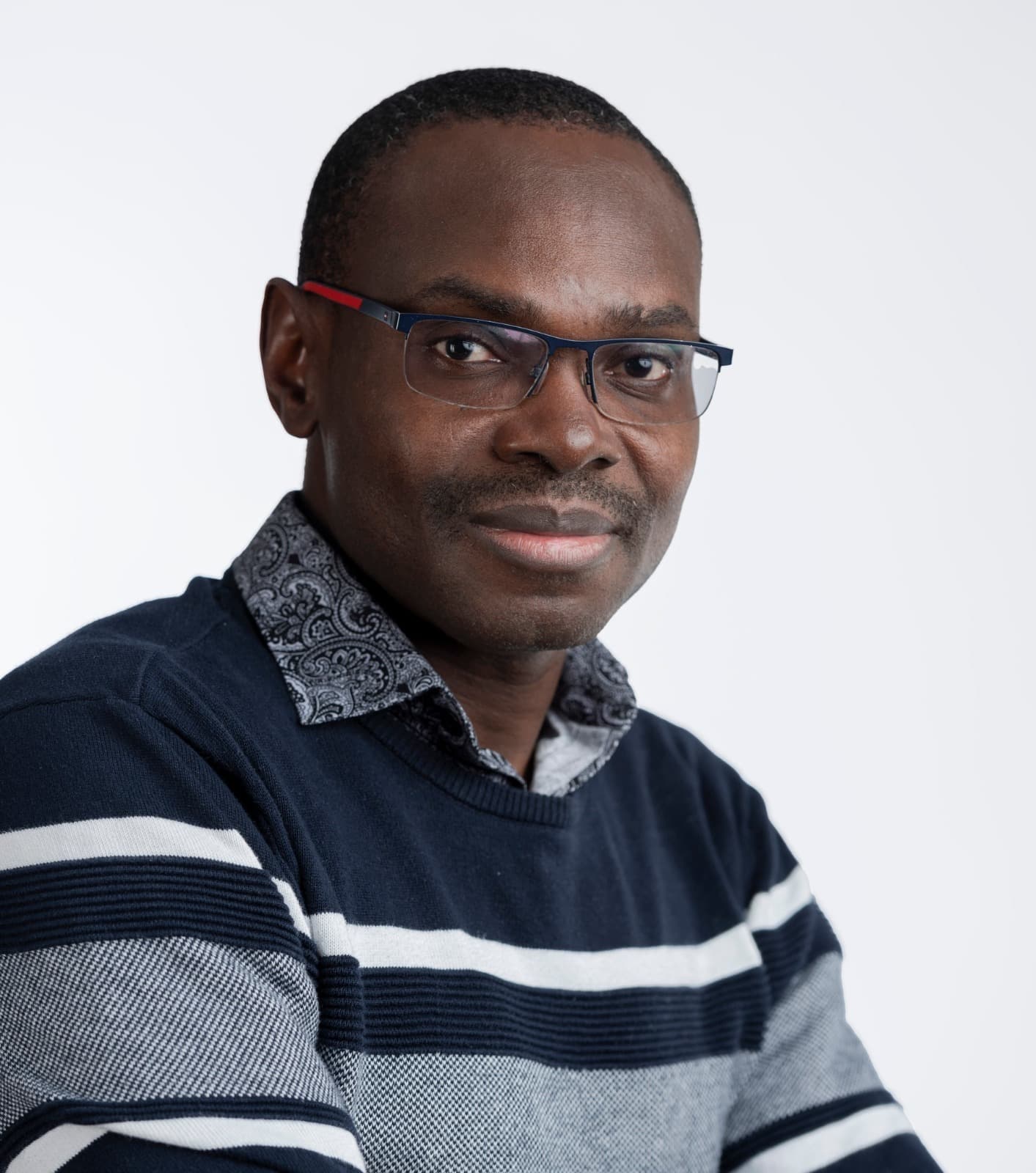
Prof. Pius A. Owolawi, PhD
Academic leadership. Research excellence. Innovation translation. Industry partnership. Student success.
The publication figure counts the 184 papers indexed and searchable on this site (2007–2026); the Google Scholar profile is the authoritative record and states no separate total.
Explore by Opportunity
Research Leadership
Research excellence • Publications • Funding • Graduate supervision • Research vision
“Advancing intelligent systems at the intersection of AI, communications, sensing and engineering.”
Department Leadership
Faculty development • Curriculum • Accreditation • Research growth • Student success
“Building high-performing, research-active and industry-connected academic environments.”
Faculty & College Leadership
Institutional strategy • Resource development • Industry engagement • Innovation
“Academic leadership that connects research excellence, technology innovation, student development and external impact.”
Research Center Leadership
Outstanding researchers • Research identity • Funding • Infrastructure • Partnerships
“Building multidisciplinary research ecosystems from ideas, talent and infrastructure to funding, partnerships and impact.”
AboutAcademic Leadership at the Intersection of Research, Engineering and Innovation
Prof. Pius Adewale Owolawi is an academic leader, electrical and computer engineering researcher, technology innovator and educator whose career bridges higher education, artificial intelligence, engineering, research development, industry collaboration and societal impact.
Academic Leadership at the Intersection of Research, Engineering and Innovation
Prof. Pius Adewale Owolawi is an academic leader, electrical and computer engineering researcher, technology innovator and educator whose career bridges higher education, artificial intelligence, engineering, research development, industry collaboration and societal impact.
Biography
He currently serves as Assistant Dean for Industry Liaison, Special Projects and Work-Integrated Learning in the Faculty of Information and Communication Technology at Tshwane University of Technology. In this role, he works across academic programs, employers, government institutions, skills-development organizations and innovation initiatives to strengthen graduate employability, experiential learning, research collaboration and externally supported strategic programs.
He also serves as a Research Chair in Fourth Industrial Revolution Skills Development, leading work in AI, machine learning, digital platforms, IoT, intelligent systems, postgraduate training and technology-enabled workforce development.
Previously, Prof. Owolawi served for nearly eight years as Head of Computer Systems Engineering, following earlier leadership as Head/Acting Head of Electrical Engineering and Faculty Research Chair. Across these appointments, he has led curriculum modernization, professional accreditation, academic program development, postgraduate expansion, faculty mentorship, laboratory and infrastructure development, externally funded research and skills programs, industry and government partnerships, student success initiatives, work-integrated learning and emerging-technology adoption.
My Academic Philosophy
I believe universities have four fundamental responsibilities:
Create Knowledge
Advance research that expands human understanding and solves important problems.
Develop People
Educate students, mentor researchers and support faculty growth.
Build Capability
Create laboratories, curricula, research environments, partnerships and institutional systems that outlast individual projects.
Translate Knowledge Into Impact
Connect academic expertise with industry, government and communities to create economic, technological and societal value.
Professional Journey
Engineering Practice
My professional career began in network and engineering environments before expanding into academic teaching, research and university leadership.
Scholar & Educator
My research career developed from telecommunications, RF propagation and engineering systems into artificial intelligence, intelligent systems, computer vision, IoT and interdisciplinary applications.
Department Leader
I have led academic departments in both Computer Systems Engineering and Electrical Engineering, with responsibility for faculty, curriculum, research, accreditation, infrastructure and external engagement.
Research & Innovation Leader
My current portfolio connects AI, 4IR, digital transformation, postgraduate research, smart infrastructure, industry partnerships and workforce development.
Academic Qualifications
- PhD — Electronic Engineering
University of KwaZulu-Natal - MSc — Electronic Engineering
University of KwaZulu-Natal - BTech (Hons) — Applied Physics/Electronics
Federal University of Technology, Akure - Advanced Diploma — Remote Engineering, Mechatronics & Robotics
Engineering Institute of Technology - Postgraduate Program — Artificial Intelligence & Machine Learning
University of Texas at Austin - Postgraduate Program — Data Science & Business Analytics
University of Texas at Austin - Postgraduate Program — Cybersecurity
University of Texas at Austin - Postgraduate Program — Cloud Computing
Great Lakes Institute of Management - Management Development Programme
University of Stellenbosch Business School - LLB — In Progress
University of South Africa
Academic LeadershipBuilding Research-Active, Student-Centered and Industry-Connected Academic Units
My leadership approach combines academic quality, people development, research growth, innovation, student success and external engagement — transparent execution, disciplined resource allocation and measurable outcomes.
Building Research-Active, Student-Centered and Industry-Connected Academic Units
My leadership approach combines academic quality, people development, research growth, innovation, student success and external engagement — transparent execution, disciplined resource allocation and measurable outcomes.
Leadership Philosophy — Collaborative. Clear. Accountable.
Develop People
Create conditions in which faculty, staff and students can develop, contribute and succeed.
Strengthen Research
Mentoring, infrastructure, postgraduate students, partnerships and disciplined funding development.
Protect Academic Quality
Rigorous curricula that evolve with technology, professional practice and student needs.
Create Student Opportunity
Improved progression, research opportunities, professional experience and graduate success.
Build External Relationships
Strategically aligned partnerships with industry, government, alumni and communities.
Measure Progress
Strategy translated into specific outcomes in research, teaching, students and resources.
Leadership Timeline
Assistant Dean — Industry Liaison, Special Projects & WIL
2025 – PresentTshwane University of Technology · Faculty of ICTFaculty-wide university–industry partnerships, work-integrated learning, graduate employability, strategic special projects, national skills initiatives, emerging-technology programs and AI-enabled workforce development.
4IR Research Chair
2022 – PresentFourth Industrial Revolution Skills DevelopmentResearch, postgraduate development, AI/IoT innovation, digital platforms and workforce capability.
Head — Computer Systems Engineering
2017 – January 2025Tshwane University of TechnologyLed strategic curriculum reforms and professional accreditation; expanded postgraduate programs; established advanced research and teaching laboratories; expanded research in AI, robotics, embedded systems and communications; managed R46M+ in externally supported WIL, research and capacity-building programs; mentored academic staff toward postgraduate qualifications.
Head / Acting Head — Electrical Engineering
2012 – 2016Mangosuthu University of TechnologyProgram leadership, curriculum modernization, accreditation readiness, infrastructure expansion and industry engagement with organizations such as Eskom, Transnet and the South African Navy.
Faculty Research Chair
2012 – 2017Engineering FacultyResearch strategy, postgraduate research development, faculty research growth, funding initiatives and international partnerships.
Case Study — From Department Administration to Research Ecosystem
Challenge
Expand research and postgraduate capacity within an engineering/computing academic unit.
Leadership Response
Expanded postgraduate activity • developed academic staff • established new research laboratories • built external funding partnerships • integrated AI, robotics, embedded systems and IIoT.
Evidence of Scale
R46M+ secured/managed across WIL, research and capacity development • IIoT and advanced technology laboratories • faculty postgraduate mentoring • expanded research productivity.
Department Leadership
Building high-performance academic departments. My department-leadership experience spans faculty development, curriculum modernization, accreditation, research strategy, student success, postgraduate education, external funding, laboratories, industry partnerships and institutional innovation.
People
Recruit, mentor and retain excellent faculty.
Research
Create conditions for sustained scholarship and externally funded programs.
Students
Strengthen progression, experiential learning and professional pathways.
Curriculum
Protect disciplinary rigor while evolving with technology.
Resources
Align budgets, infrastructure and funding with strategic priorities.
Partnerships
Connect the department to the wider university, industry and community.
Faculty & College Leadership — What I Bring
Connecting strategy, people, research and external impact. My faculty-level leadership experience operates at the intersection of academic strategy, industry engagement, research and innovation, student success, work-integrated learning, external funding, digital transformation, workforce development and public-sector partnership.
Research Credibility
Sustained interdisciplinary publication portfolio spanning AI, engineering, communications and intelligent systems.
Academic Leadership
Departments, research portfolios, curriculum reform, accreditation and faculty development.
Resource Development
Significant funding mobilized for research, infrastructure, student development and innovation.
Talent Development
Extensive postgraduate supervision and faculty mentoring across AI and intelligent systems.
Innovation Translation
Ideas moved from research through prototypes, laboratories and institutional deployment.
External Engagement
Partnerships with utilities, government agencies, training authorities, firms and universities.
I bring the ability to work across academic and external environments — to understand faculty priorities while also translating university capabilities into meaningful relationships with government, industry and communities.
Leadership vision: People → Programs → Research → Resources → Partnerships → Impact
Leadership VisionSix Priorities for the Future of Computing & Engineering Education
Six Priorities for the Future of Computing & Engineering Education
Six Priorities
1. Faculty Excellence
Recruit excellent people and create environments in which scholarship, teaching and service are supported through transparent processes and meaningful mentorship.
2. Research Growth
Develop strong investigator-led scholarship while creating structures that make interdisciplinary research and major collaborative grants easier.
3. Student Success
Build pathways connecting foundational learning, laboratories, research, professional practice, internships, capstones and graduate education.
4. Future-Ready Curriculum
Maintain strong disciplinary foundations while responding deliberately to AI, cybersecurity, data, automation, intelligent systems and emerging engineering technologies.
5. External Engagement
Strengthen connections with industry, government, alumni and communities to create research opportunities, professional experiences, philanthropy and workforce development.
6. Innovation & Translation
Help ideas move through a structured pathway: Research → Prototype → Validation → Partnership → Deployment → Commercialization.
First-Year Leadership Approach
For a new Chair, Director or Dean appointment, my first year would follow:
ResearchIntelligence for Connected Physical Systems
My research investigates how learning, sensing, communications and computation can be combined to create intelligent systems capable of operating under real-world constraints.
Intelligence for Connected Physical Systems
My research investigates how learning, sensing, communications and computation can be combined to create intelligent systems capable of operating under real-world constraints.
Seven Connected Research Directions
Artificial Intelligence & Machine Learning
Deep learning • transformers • generative AI • ensemble learning • transfer learning • predictive analytics • time-series forecasting • anomaly detection • explainable AI.
Computer Vision & Intelligent Perception
Object detection • segmentation • visual inspection • human activity recognition • autonomous monitoring • 2D-to-3D reconstruction • assistive technologies.
Future Communications
RF/FSO • millimeter-wave propagation • 5G/6G • satellite • channel modeling • AI-enabled QoS prediction • reconfigurable intelligent surfaces.
IoT, Edge & Cyber-Physical Systems
Industrial IoT • distributed sensing • edge/cloud • embedded intelligence • smart factories • predictive maintenance.
Energy & Smart Infrastructure
Renewable energy • hybrid systems • demand-side management • smart grids • AI forecasting • digital twins.
Robotics & Autonomous Systems
UAVs • embedded robotics • BCI-controlled systems • human-machine interaction • smart mobility • intelligent control.
Responsible & Inclusive AI
Low-resource language technology • assistive AI • digital inclusion • AI governance • data privacy • rural/community innovation.
Future Research Agenda
Graduate Education & Mentorship
Mentorship Philosophy →Supervision and mentorship spanning master's, doctoral and postdoctoral researchers across AI, computer vision, intelligent systems, communications, 5G, optical systems, optimization, renewable energy, robotics and EEG/BCI.
Research Leadership
Building trustworthy intelligent systems for a connected world — my scholarly trajectory connects more than two decades of engineering research with contemporary work in artificial intelligence, intelligent systems, communications, IoT, computer vision and cyber-physical infrastructure.
Graduate Education & MentorshipDeveloping Researchers and Future Academic Leaders
Graduate education is one of the most important responsibilities of a senior academic. My supervision and mentorship experience spans master's, doctoral and postdoctoral researchers working across AI, computer vision, intelligent systems, communications, 5G, optical systems, optimization, renewable energy, robotics and EEG/BCI.
Developing Researchers and Future Academic Leaders
Graduate education is one of the most important responsibilities of a senior academic. My supervision and mentorship experience spans master's, doctoral and postdoctoral researchers working across AI, computer vision, intelligent systems, communications, 5G, optical systems, optimization, renewable energy, robotics and EEG/BCI.
Mentorship Philosophy
Research Culture
I encourage graduate researchers to develop:
Publications & Scholarly Impact184 Peer-Reviewed Publications
Spanning electrical engineering, communications, artificial intelligence, intelligent systems, computer vision, IoT, energy systems and interdisciplinary applications — every entry below is drawn from the Google Scholar record, filterable by research area.
184 Peer-Reviewed Publications
Spanning electrical engineering, communications, artificial intelligence, intelligent systems, computer vision, IoT, energy systems and interdisciplinary applications — every entry below is drawn from the Google Scholar record, filterable by research area.
Featured Research
184 publications found
A Stacking-Based Ensemble Learning Model for Robust Intrusion Detection in IoT Networks
Computing Conference, 539-549 · 2026
CAE-StackedNet: A Hybrid Convolutional Autoencoder and Stacked Ensemble Framework for Histopathological Breast Cancer Image Classification
Annals of Data Science, 1-22 · 2026
HistoEffiCrossFormer: Cross-Attention CNN–Transformer Fusion with Multi-Scale Tokens for Ovarian Cancer Histopathology Classification
IndabaX Nigeria Conference, 320-330 · 2026
INT8 Quantisation for Cassava Leaf Disease Classification on Raspberry Pi
IndabaX Nigeria Conference, 167-178 · 2026
Integrating AI and IoT (AIIoT) for Modern Traffic Systems
2026 4th Cognitive Models and Artificial Intelligence Conference (AICCONF), 1-6 · 2026
Intelligent optimisation for onshore wind farm battery energy storage systems
Intelligent Systems with Applications, 200667 · 2026
Intelligent optimisation for sustainable development of onshore wind farm battery energy storage systems: A systematic review
Energy Strategy Reviews 64, 102109 · 2026 · 2 citations
Interpretable CRAM‑Enhanced Lightweight Dual‑Branch CNN for Real‑Time Breast Cancer Histopathology in Internet‑of‑Medical‑Things Environments
Small 22 (26), e09066 · 2026 · 1 citation
Learning Hidden QoS Structures in Cellular Networks: A Context-Aware Benchmark of Unsupervised Clustering Methods with a New QoS Cluster Validity Protocol
Electronics 15 (12), 2666 · 2026
LExNet: A bio-inspired lightweight ensemble model for breast cancer classification using hybrid autoencoder and swarm intelligence optimization
Digital Health 12, 20552076261435030 · 2026
Machine learning-based enhanced visibility framework and predictive fog-and precipitation-induced attenuation modeling of subtropical free-space optical communication links
Optics Communications, 132897 · 2026 · 1 citation
Minimization of Variations in EEG Neural Dynamics using Transfer Learning Algorithm
2026 IEEE International Conference on Pattern Recognition, Machine Vision … · 2026
Full Scholarly Profile
Research Centers & LaboratoriesBuilding the Infrastructure Where Innovation Happens
I have led or contributed to the establishment and development of multiple specialized teaching and research facilities — capacity building that outlasts individual projects.
Building the Infrastructure Where Innovation Happens
I have led or contributed to the establishment and development of multiple specialized teaching and research facilities — capacity building that outlasts individual projects.
Laboratory Portfolio
4IR Innovation Laboratory
AI • Machine Learning • IoT • Robotics • Smart Systems
Support research, postgraduate training, innovation and applied emerging-technology projects.
Emerging Technologies Laboratory
Computer Vision • AR/VR • AI • IoT • Data Science
Emerging Industrial IoT Laboratory
Industrial Sensors • Embedded Systems • Edge Computing • Intelligent Monitoring
Drone Technology Laboratory
UAV Development • Aerial Imaging • Smart Agriculture • Remote Sensing
Radio Propagation & Wireless Communications Laboratory
5G • FSO • mmWave • Satellite • RF Analysis
Renewable Energy Laboratory
Solar • Hybrid Energy • Power Systems • Intelligent Energy
EMC / EMI Laboratory
Electromagnetic Compatibility • Signal Integrity • Engineering Testing
Mechatronics Laboratory
Robotics • Actuation • Intelligent Control • Prototyping
Research Center Leadership
From research themes to sustainable research ecosystems. Successful centers require:
My experience includes research-chair leadership, faculty research leadership, research-group development, laboratory establishment, postgraduate supervision, funded programs and interdisciplinary technology initiatives.
Center Leadership Agenda
- Define distinctive research strengths.
- Recruit and develop talent.
- Create a disciplined grant pipeline.
- Develop shared research infrastructure.
- Build national and international collaborations.
- Engage industry and government.
- Develop students and postdoctoral researchers.
- Translate research into meaningful impact.
Strategic ProjectsStrategic Research & Transformation Programs
Major programs connecting research capability with government, utilities and industry — each showing leadership role, challenge and contribution. Roles are stated precisely; outcomes are published only once validated.
Strategic Research & Transformation Programs
Major programs connecting research capability with government, utilities and industry — each showing leadership role, challenge and contribution. Roles are stated precisely; outcomes are published only once validated.
Program Portfolio




Innovation & Research TranslationFrom Research to Real-World Systems
Deployed institutional systems, digital platforms, research prototypes and emerging technologies — every project labelled by maturity so committees never confuse an idea, a prototype and a deployed solution.
From Research to Real-World Systems
Deployed institutional systems, digital platforms, research prototypes and emerging technologies — every project labelled by maturity so committees never confuse an idea, a prototype and a deployed solution.
Innovation Status System
Market / Institutional Platforms
Developed with Emerging Tech Solutions, where Prof. Owolawi serves as Technical Director.
WILMS
Work-Integrated Learning management system — student preparation, placement, employer interaction, monitoring, reporting and evaluation.
Market-Facing PlatformEngageLearn
Enterprise learning-management platform — content, assessment, analytics, collaboration and reporting.
Institutional DeploymentMICT SETA Learning Platform
Digital learner-management and national skills platform for learner data and document administration.
Institutional DeploymentVUT WILMS
Institutional work-integrated learning implementation for Vaal University of Technology.
Institutional DeploymentUJ CareerWiz
University career-services and employer-engagement platform supporting graduate recruitment.
Deployed PlatformSSCN — Field Workforce Monitoring
Cross-platform mobile solution supporting field workforce and program monitoring.
Emerging Innovation Portfolio
Smart Agriculture
Agricultural spraying drone • AI weed and disease detection • hyperspectral crop monitoring • livestock monitoring • autonomous seeding and fertilization • smart irrigation • agricultural e-commerce • digital farmer collaboration.
Robotics & Assistive Technologies
EEG/BCI robot control • intelligent mobility aids • AI fall detection • speech-command accessibility systems • sign-language recognition • human-gesture interfaces.
Computer Vision
Intelligent vehicle security • biometric recognition • quality inspection • agricultural disease detection • infrastructure monitoring • autonomous perception.
Energy & Smart Infrastructure
Hybrid renewable systems • smart meters • demand-side management • renewable-energy optimization • intelligent lighting • predictive maintenance.
Funded Programs & Resource DevelopmentR94.2M+ Documented Portfolio (≈ US$5M)
Research, postgraduate support, innovation, academic infrastructure, student development, workforce programs and technology-enabled skills initiatives — presented transparently by category.
R94.2M+ Documented Portfolio (≈ US$5M)
Research, postgraduate support, innovation, academic infrastructure, student development, workforce programs and technology-enabled skills initiatives — presented transparently by category.
Portfolio by Program Type
Supporting hundreds of learners through professional and experiential education.
Supporting large-scale skills development.
Supporting research, postgraduate development and digital innovation.
Supporting innovation, technology development and research infrastructure.
Supporting advanced academic laboratories and technical facilities.
The portfolio includes competitive research, innovation, infrastructure, postgraduate, workforce-development and experiential-learning programs — not solely investigator research grants.
Funding Philosophy
Funding should leave behind more than expenditure and reports.
A successful funded program should create: People • Knowledge • Infrastructure • Publications • Intellectual Property • Partnerships • Student Opportunities • Institutional Capability.
Teaching & Student SuccessEducation Must Connect Knowledge to Practice
My teaching philosophy can be summarized as: Understand → Design → Build → Test → Reflect → Apply. Students should leave university with both strong disciplinary foundations and the ability to solve unfamiliar problems.
Education Must Connect Knowledge to Practice
My teaching philosophy can be summarized as: Understand → Design → Build → Test → Reflect → Apply. Students should leave university with both strong disciplinary foundations and the ability to solve unfamiliar problems.
Teaching Approach
Educational Leadership
Teaching Recognition
Vice-Chancellor's Teaching Excellence Award
Best Engineering Mentor
Industry & PartnershipsAcademic–Industry–Government Partnerships
Universities achieve greater impact when external engagement is strategic, reciprocal and academically meaningful.
Academic–Industry–Government Partnerships
Universities achieve greater impact when external engagement is strategic, reciprocal and academically meaningful.
Partnership Categories
Selected Partners & Stakeholders
Eskom
Transnet
South African Navy
Department of Water and Sanitation
Department of Electricity and Energy
MICTSETA
AgriSETA
BANKSETA
CHIETA
GIZ
SANEDI
Universities and TVET colleges
Industry and engineering technology partners
International Research Collaboration
Research partnerships span institutions in:
Areas include:
Awards & RecognitionAwards & Academic Recognition
Selected honors include:
Awards & Academic Recognition
Selected honors include:
Top 500 African Researchers
Recognition for scholarly output and research impact.
Senior Researcher of the Year
Tshwane University of Technology
Senate Research Excellence Award
Tshwane University of Technology
Most Outstanding Researcher
Faculty of Engineering
Vice-Chancellor's Teaching Excellence Award
Brown International Advanced Research Institute Alumnus
Brown University
Best Paper Award
International conference recognition.
Best Engineering Mentor
University of KwaZulu-Natal
Keynotes, Media & Thought LeadershipIdeas & Public Engagement
Speaking and thought-leadership themes include:
Ideas & Public Engagement
Speaking and thought-leadership themes include:
Keynotes & Conferences
A selection of keynotes and conference talks will be published here shortly.
Media & Commentary
Interviews, articles, podcast appearances and university features will be published here shortly.
Candidate ResourcesAcademic & Leadership Documents
For executive search committees, universities and research institutions. Each document is tailored to a specific search type.
Academic & Leadership Documents
For executive search committees, universities and research institutions. Each document is tailored to a specific search type.
Document Library
Full Academic CV
The complete academic record — appointments, publications, funding, supervision, service and awards.
Academic Leadership Statement
Leadership philosophy, priorities and first-year approach.
Graduate Supervision Portfolio
Master's, doctoral and postdoctoral supervision record.
Technology With a Human Purpose
I believe innovation should expand opportunity.
Community & Social-Impact Activities
Assistive Technology
Development of intelligent mobility solutions for visually impaired users.
Student Mentorship
Career and postgraduate-development support for talented students from disadvantaged backgrounds.
Community Skills Development
Hands-on technical and technology-support initiatives.
Rural Innovation
Supporting small enterprises and agricultural communities through digital tools, drones, IoT and precision-agriculture technologies.
Digital Inclusion
Developing affordable ICT and AI systems for underserved environments.